
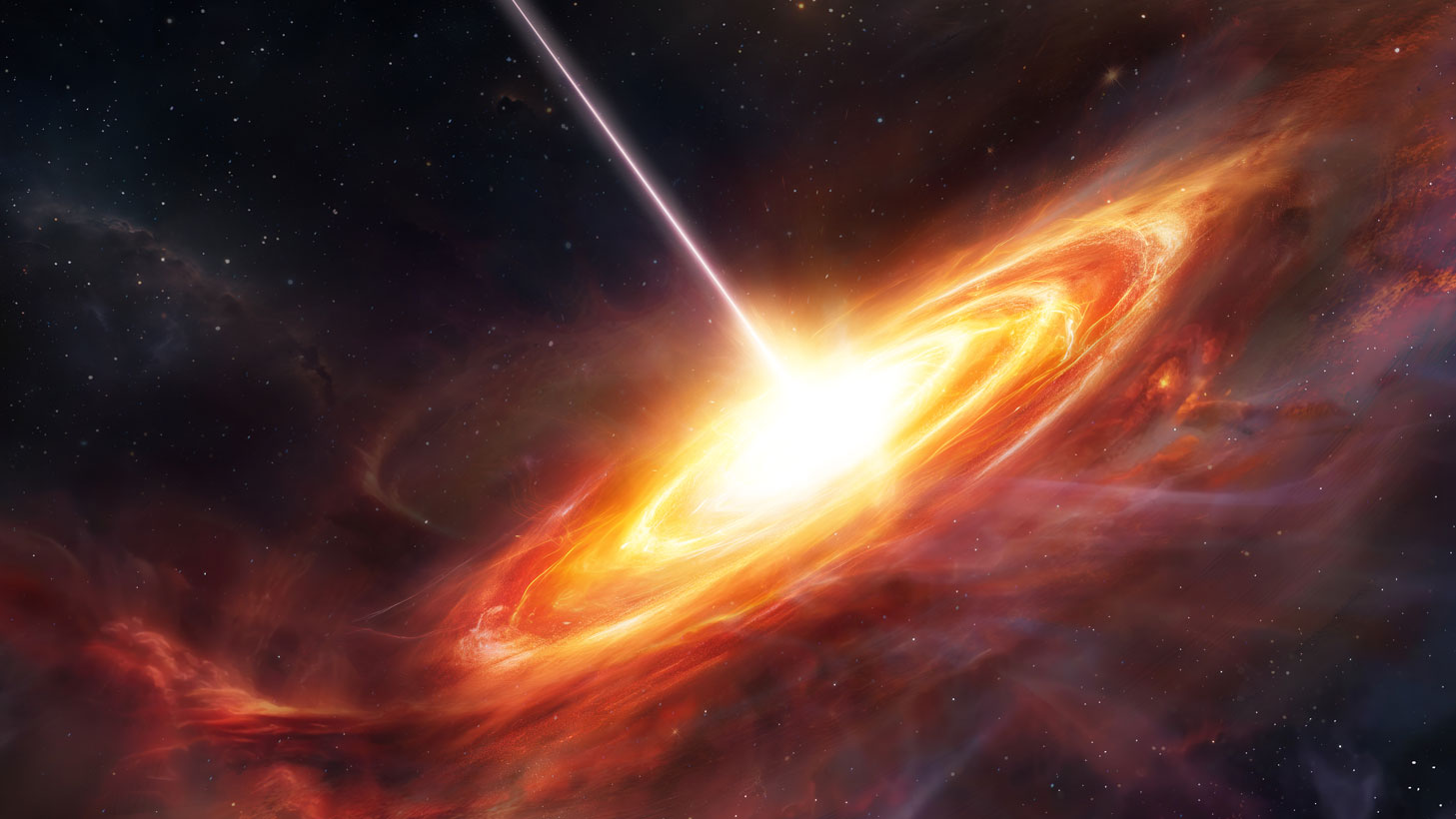
An AI model helped scientists find out more about how supermassive black holes grow, a recent study details. The new findings were published in the The Astrophysical Journal on July 22nd. Astronomers spotted 7 new quasars that act like gravitational lenses. All that by using artificial intelligence to sweep through the data from the Dark Energy Spectroscopic Instrument (DESI).
“Quasars are like the baby pictures of a supermassive black hole. So exploring how we get from quasars to those black holes is really important,” said Everett McArthur of The Ohio State University and the lead author of the study in his statement.
Why Are Quasars Important In Studying Supermassive Black Holes?
In short, studying quasars sheds some light on how black holes turn into supermassive black holes. As the enormous black holes at the center of far-distant galaxies suck in dust and gas, they release significant amount of energy, making it really difficult for astrophysicists to study those galaxies.
However, quasars acting like gravitational lenses gives scientists the opportunity to study the respective quasars, as well as the distant galaxies. The biggest problem is that the astronomers don’t know many such quasars. And that’s when AI kicked in.
How Did the AI Model Help Scientist Find Quasars Acting Like Gravitational Lenses?
The scientists used the AI to study approximately 800,000 quasars from one of the Dark Energy Spectroscopic Instrument’s data catalogs. The machine-learning model’s mission was to find signatures of gravitational lensing.
As there is few real-world data on quasars acting as gravitational lenses, the researchers trained the AI model with simulations of such space objects. The artificial intelligence eventually searched through the DESI catalog and uncovered 200 possible candidates. Afterwards, the astronomers manually checked the results, leading to 7 best candidates.
Even though more observations have to be conducted to confirm the findings, this study shows how AI can help astronomers narrow down the billions of data to a manageable number. In this case, the discovery might eventually give us precious intel on supermassive black holes.